How To Build a SaaS With AI (The Step 0 Most Founders Skip)
Building with AI is cheap now. The founders who win validate the problem and sign real buyers before they write a single line of code.
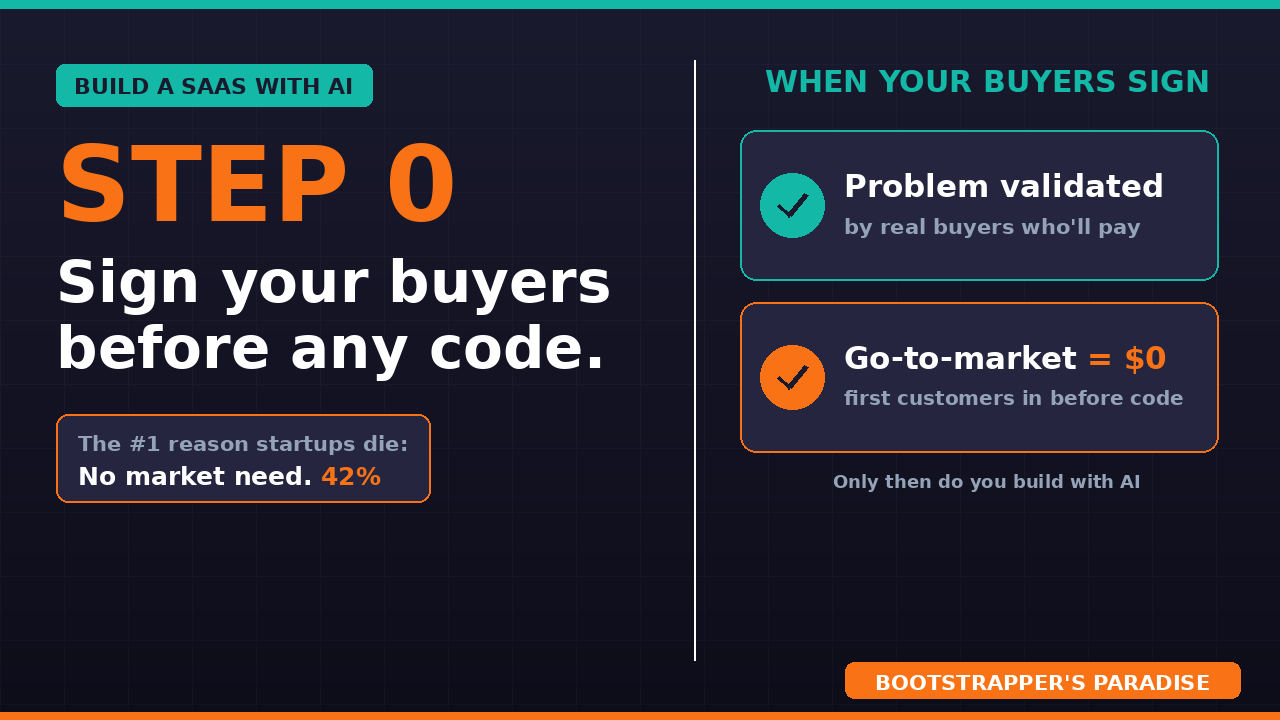
Building got cheap, so the build is not what makes or breaks you anymore. By the end of this, you will know how to build a SaaS with AI the way that creates a real business, not a hobby, even solo with no team.
Here is the angle up front. Building got cheap, which makes validation more important now, not less. The real work happens at Step 0, before you write any code.
Why most SaaS dies
Let me talk about why most SaaS products die, and why building faster will not save you.
AI made building so cheap that this feels right: just build it and let the market decide. That is the trap. You can ship in a weekend and still waste months if the problem is not real.
The top reason startups die is not money. CB Insights studied hundreds of failures, and no market need was number one, around 42%. Running out of cash shows up even more often, near 70%. That is the symptom, not the cause. The cash runs out because nobody is buying. It is basically a different way to describe the same problem.
My first SaaS
Let me tell you about my first SaaS, so you do not repeat it.
It was a cool idea I came up with on my own, and I was sure the market wanted it. I built a real solution to a problem the market did not yet have. The trouble was that nobody actually wanted it.
Here is the lesson: just because you can build it does not mean you should. I vowed never to make that mistake again, and now I am warning you off the same trap.
Hobby vs business
So what is the real difference between a hobby and a business? It comes down to this.
A hobby is a cool thing you build that people who are not you do not really want. A business is a validated problem in a market that is demanding a better solution, which ultimately becomes your product.
The shift from hobby to business happens before you write any code. It is the unique combination of a verified problem and a buyer who wants the fix.
Step 0: recruit your buyers as advisors
Here is the move I make before I write a single line of code now.
I go to the exact people I plan to sell to, and I turn them into official advisors. That means I share a point or two of equity for their guidance and their help with go-to-market. Then I put a real advisor agreement in front of them, and we both sign it.
That signature changes everything. A polite "sounds great" at dinner means nothing. A signed advisor with a stake tells you the truth, because now they have a vested interest in your success.
The moment they sign, two things happen
Two things happen the moment those advisors sign, and this is the whole game.
First, the problem is validated by the people who will actually pay for the fix. No more guessing.
Second, your go-to-market collapses to zero. Your first customers are already in before the product exists.
Go-to-market is the single biggest thing that kills bootstrappers, and this move takes it off the table on day one. Clockless is my example. The idea came from the market, not my head, and the buyers were advisors before I wrote a line of code. I run this same pattern every time, and so far it has not failed me.
Now you build, and it's the easy part
Only now does the build start, and it is the easy part.
You are not guessing what to build, because your advisors already told you the problem and the shape of the fix. AI writes the code against a spec that came from real buyers, so you build the right thing fast instead of heading in the wrong direction. You launch into a market that is already waiting, with your first customers already riding along.
Why would anyone sign for an unbuilt idea?
You might be thinking, why would real prospects sign an advisor agreement for an unbuilt idea?
The answer is in the order. The idea came from their market and their pain, so they already feel the problem. A stake in the solution they want, plus a real say in how it is built, is worth signing for. That privilege would cost them anywhere from tens to hundreds of thousands of dollars if they hired someone else to build it for them.
If you cannot find anyone willing to advise, that is not a setback. That is your validation telling you to stop early and rethink your plan. This process just saved you a ridiculous amount of time and money.
Your playbook to follow
- Find a problem in a market you can actually reach.
- Take it back to real prospects.
- Sign them as advisors with a stake.
- Build the fix with AI against what they tell you.
- Launch with your first customers already on board.
Business, not a hobby
Remember the line. Building got cheap, but the build is not what makes or breaks your SaaS. A validated problem and a buyer locked in before code is what turns a SaaS into a real business.
If you want help finding a real, painful problem worth building around, I built a free Problem Finder.
If you want my help running this exact pattern for your SaaS, I work with a small number of founders one on one. Details at bootstrappersparadise.com.
Ready to Build Your Own SaaS?
Learn how to go from idea to launch in my free 5-day email course — no coding or big budget required.
Start the Free Course