Build a SaaS Without Quitting Your Day Job
AI lets solo founders keep their paycheck, build SaaS part-time, and go full-time only after the business out-earns their salary.
You do not have to quit your job to build a SaaS. You do not have to raise money, you do not have to bet your mortgage, and you do not have to go all in and hope it works before your savings run out.
That used to be the only path. It is not anymore, because AI changed the game completely. AI is the great equalizer. It lets you keep your paycheck and build a real software business at the same time, part-time and entirely on your own. Here is exactly how that works, why keeping your day job actually makes you more likely to succeed, and the operating model I run myself. If I can do it, so can you.
The old way was all-or-nothing
Let me start with why this used to be so hard, because it explains everything.
To build software, you needed a team: engineers, designers, the whole thing. You had to hire them, manage them, and pay them. To pay a team, you needed funding: real money, up front, before you had made a single dollar.
Here is the trap. To get that funding, you had to go all in. No investor was writing you a check to work on it on the weekends. They wanted you to quit your job, bet everything, and prove you were fully committed. The price of entry was your entire livelihood. You take all the risk, while for the investor it is just another bet they hope pays off. That all-or-nothing wall locked almost everyone out, for good reason. Most people cannot, and should not, just walk away from their income to gamble everything on an untested idea.
AI is the great equalizer
Here is what changed. AI knocked that wall down. It is the great equalizer, and this is the whole reason this article exists.
Now you can do all of this by yourself. There is no team to hire, because the AI is your team. There is no funding to raise, because you are not paying anyone. It is just you and the tools.
That means you can build what you want whenever you want. A few focused hours on a weeknight, a solid session on a Saturday, and you make real, visible progress. The thing that used to require a war chest and a full-time leap now fits into the margins of a normal life. That is a genuine possibility, and most people have not updated their thinking yet.
So keep your day job
Here is the move that flips this from interesting to obvious. Do not quit. Keep your day job.
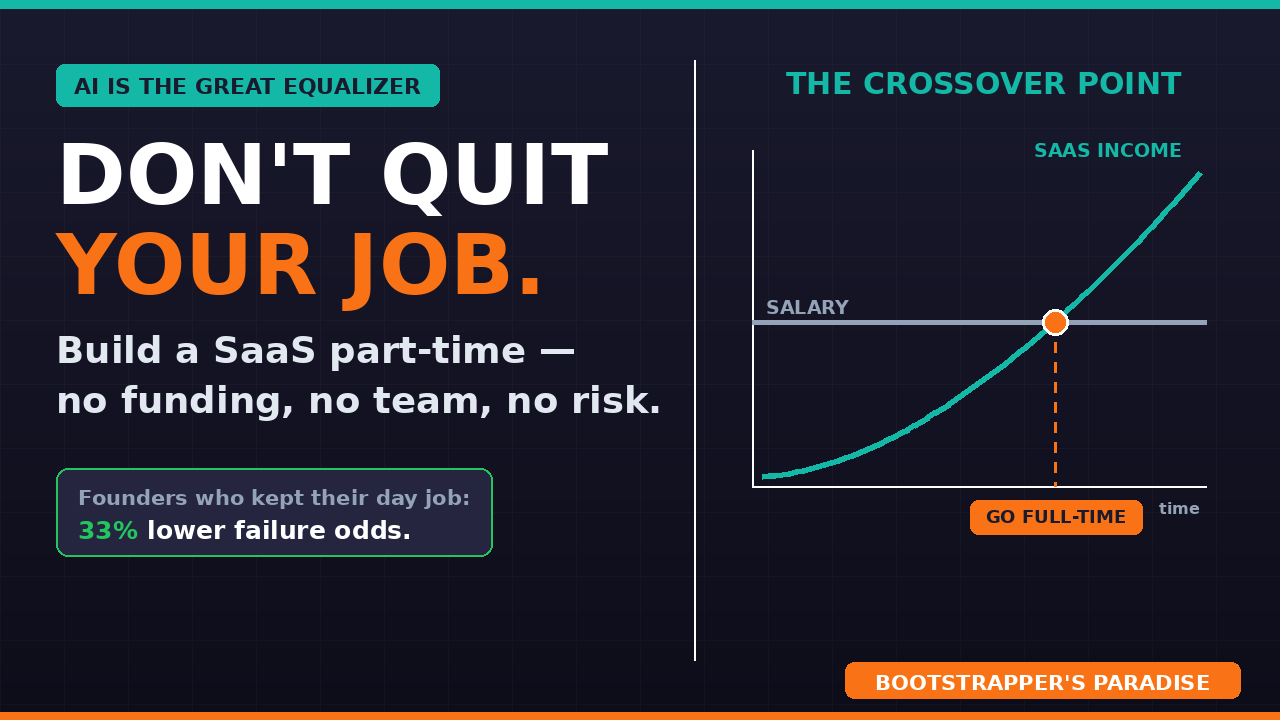
I know that sounds backwards, so let me give you the data. A 15-year study of more than 5,000 entrepreneurs found that the ones who kept their day jobs had 33% lower odds of failure than the ones who quit to go all in. Keeping your income did not make you less of a founder. It made you more likely to win.
Here is why that makes sense. When you are not desperate, you make better decisions. You are not forced to ship something broken because rent is due. You build until your SaaS is genuinely more successful than your career, and only then do you switch your focus to it full-time. You de-risk the whole thing down to a no-brainer decision.
The crossover point
Let me make the switch concrete, because this is the part that removes the fear.
You run your SaaS on the side while your salary keeps the lights on. Your salary is a flat line. Your SaaS income starts at zero and climbs. You wait for the moment those two lines cross, when your SaaS is bringing in more than your job.
That crossover is your signal. That is when you go full-time, from a position of strength, with a business that has already proven it out-earns your career. Until that moment, your risk is basically zero, because you never gave up your paycheck to find out.
Swing as many times as you need
Here is the part most people get wrong. They think they get one shot. With a day job, you can actually get unlimited shots.
Say you have to build five, even ten products before one really hits. Under the old model, that was five or ten chances to go bankrupt. Under this model, it does not matter at all, because you had steady income the entire time. A miss is not a strikeout. It is just your next at-bat, now armed with all the lessons from the previous misses.
No single failure can take you out of the game. That completely changes how you play it. You can be patient, you can experiment, and you can keep swinging until one of them connects, which is exactly how a portfolio is supposed to work.
The career and SaaS flywheel
Here is the bonus that makes this even better, and it surprises people. Your job and your SaaS do not have to compete. They can compound.
Keep your job for the steady income. On top of that, building a SaaS on the side hands you brand-new, in-demand skills. Those skills make you more valuable, which helps you land better work. Better work gives you more income, more leverage, and sharper insight, which helps you build a better SaaS, which teaches you even more.
It is a flywheel. Your career feeds your SaaS, your SaaS feeds your career, and each turn makes the next one easier. You are not choosing between the two. You are using each one to strengthen the other.
My model: three income streams
Let me show you what this can look like in practice. This is what I am doing right now.
I run three income streams. The first is my SaaS portfolio, the products themselves. The second is coaching, where I help entrepreneurs who want more hands-on guidance, people exactly like you. The third is consulting, where I work with larger companies on bigger and more expensive problems in the same space.
Every one of those streams feeds the others. The building makes me a better coach. The coaching and consulting sharpen what I build. It is diversified, it is de-risked, and I enjoy the mix enough that I could do it forever. I am not sharing this as a someday dream. I am sharing it because it works, and it started exactly where you are now.
Your playbook to follow
- Keep your day job. Your paycheck is your funding and your safety net.
- Build with AI on nights and weekends. No team, no raise, just steady progress.
- Treat it as a portfolio. Swing as many times as it takes until one hits.
- Let your career and your SaaS compound each other instead of competing.
- Switch to full-time only when your SaaS out-earns your salary, not a day before.
If I can do it, so can you
That is the whole model. Keep your income, build with AI in the margins, de-risk it all the way down, and switch only when the numbers tell you to. AI took the wall that used to lock people out and turned it into a side door anyone can walk through.
If you want the full framework for building, shipping, and pricing a SaaS in this AI era, my free 5-day email course walks you through it step by step. If you want me in your corner directly, running this model on your own SaaS, I coach a small number of founders one on one through my private coaching program.
I built this life starting from a normal job with normal hours, so I mean it when I say this. If I can do it, so can you.
Ready to Build Your Own SaaS?
Learn how to go from idea to launch in my free 5-day email course — no coding or big budget required.
Start the Free Course