How to Price Your SaaS in 2026: The 3 Models Replacing Per-Seat
Per-seat pricing is dying. Here are the 3 models replacing it, the ROI math you need, and a 4-question framework to pick the right one.
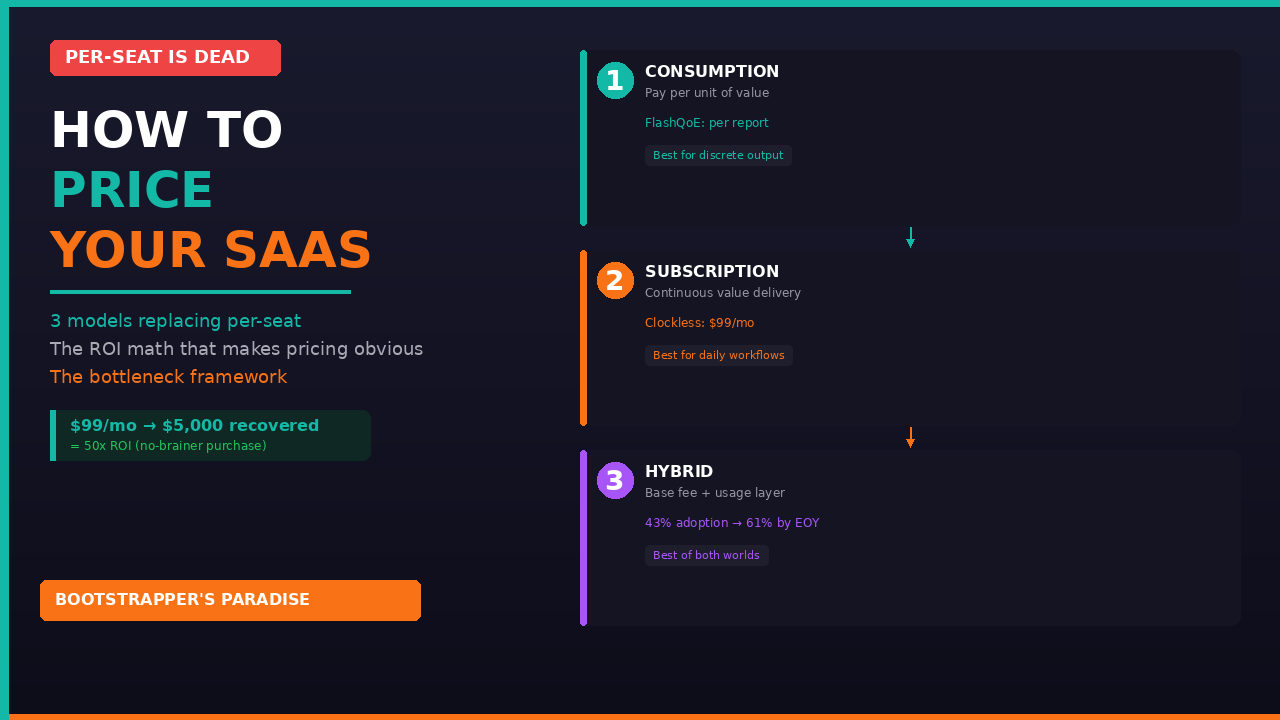
A trillion dollars was wiped from software stocks because of one simple realization: AI agents don't need seats. The per-seat pricing model that built the entire SaaS industry is dying. So if you're building a SaaS product in 2026, how do you actually price it?
Why Per-Seat Is Dying
Per-seat pricing is simple: charge a monthly fee for every person who uses your software. More employees, more seats, more revenue. Salesforce built a $300 billion company on it. It worked perfectly in a world where more employees meant more software usage.
But that world doesn't exist anymore. Imagine you sell customer support software at $50 per seat. A company with 100 support agents pays $5,000/month. Then they deploy an AI agent that handles 80% of tickets. They need 20 humans, not 100. Your revenue drops 80% — not because your software got worse, but because AI made your customer more efficient. The better AI gets, the fewer seats they need. That's a pricing model at war with itself.
The market is already moving. Seat-based adoption dropped from 21% to 15% in just 12 months. Hybrid models jumped from 27% to 41%. Gartner predicts 70% of businesses will prefer usage-based pricing over per-seat by end of 2026.
First: Calculate Your Customer's ROI
Before picking a model, you need one number: your customer's return on investment. In 2026, if your pricing doesn't make obvious financial sense, customers will demand more or leave.
You need three things. What does your product save or earn your customer (in dollars per month)? What do you charge? What's the ratio? For Clockless, if we recover $5,000 in lost billing and charge $99/month, that's a 50x ROI. The customer never questions that invoice. Aim for 10x ROI minimum. The higher, the better.
Model 1: Consumption Pricing
Pay per unit of value delivered. My product FlashQoE charges per report generated for financial due diligence assessments. Need a report? Buy one. Need a lot? Buy a block at a volume discount.
This works because customers only pay when getting value (zero waste), volume discounts incentivize larger purchases (better cash flow), and block purchases create pre-commitment (built-in retention). Consumption pricing works best when your product delivers discrete, countable units: reports, analyses, transactions, documents processed.
Model 2: Subscription Pricing
Not dead, but the rules have changed. Subscriptions still work when value is continuous. Clockless monitors meetings and billing activity every day — it's always working. A monthly subscription makes sense because the value never stops.
The key is the ratio. If Clockless recovers $5,000/month and charges $99, that's less than 2% of value. The customer never thinks about canceling. Compare that to $500/month for $600 in value — that's 1.2x ROI. The customer scrutinizes every invoice and churns at the first opportunity. Keep the ratio dramatic.
Model 3: Hybrid Pricing
Where the industry is heading. A base platform fee for access and core features, plus a consumption layer for variable usage. 43% of SaaS companies already use hybrid models, projected to hit 61% by end of 2026.
It gives you predictable base revenue plus expansion revenue from usage growth. Light users pay the base. Heavy users pay more — and they're happy to, because more usage means more value. The consumption component should feel fair, not punitive.
Free Tier vs. Trial vs. Neither
I'm not big on free tiers. They attract users who don't want to pay, fill your support queue, rarely convert, and give misleading metrics. A trial is different — it creates urgency and signals value.
The nuance: for FlashQoE, I give one report free per new account. Not a free tier — a sample. I didn't do this originally, but kept hearing the same objection: people couldn't evaluate without seeing a report first. That single change removed the evaluation barrier and unlocked conversions. The lesson: diagnose your specific bottleneck and design pricing to eliminate it. Don't copy someone else's strategy.
The 4-Question Pricing Framework
- Is your value discrete or continuous? Discrete → consumption. Continuous → subscription.
- What's your customer's ROI? If you can't calculate it, you're not ready to price. Aim for 10x minimum.
- What's the bottleneck to your first 100 customers? Design your trial/sample/pricing to eliminate that specific bottleneck.
- Would your customer feel penalized for using more? If yes, your model is wrong. More use should mean more value for both of you.
Your Superpower
Enterprise incumbents are stuck with millions of per-seat contracts they can't easily change. Every pricing adjustment is a board-level decision. You have none of that baggage. You can design the right model from day one. That flexibility is your superpower.
SaaS Pricing Calculator
The 3 models replacing per-seat pricing, ROI benchmarks, the bottleneck framework, and a 4-question decision tool to price your SaaS.
Price for value, not for seats.
Ready to Build Your Own SaaS?
Learn how to go from idea to launch in my free 5-day email course — no coding or big budget required.
Start the Free Course