Why Your Product Roadmap Should Be "Just Ship It" in 2026
AI has collapsed the cost of building. For bootstrapped SaaS founders, the fastest roadmap is to build, ship, measure, and let real usage decide.
Here's something wild I discovered while building Clockless: I can now build a feature faster than I can do the research to figure out whether I should build it.
Think about that for a second.
The time it takes to survey users, schedule interviews, analyze feedback, debate priorities, and build a business case for a single feature — that's now longer than it takes to just build the thing.
That realization has changed everything about how I run my product roadmap. And it should change yours too.
How Roadmaps Used to Work (And How Most Companies Still Run Them)
A customer asks for a feature. It goes into the backlog. Someone writes a user story. The product team debates it. They schedule UX research interviews. They run surveys. They interview five more people to confirm the need is widespread enough to justify the effort.
Then someone estimates dev time. Two sprints, maybe three. They weigh it against everything else on the roadmap. They prioritize, plan, assign the work.
By the time the feature ships, three to six months have passed. Sometimes longer.
That process made sense when building was expensive. When every feature required a team of engineers and weeks of development, you had to be sure before you committed those resources.
That world doesn't exist anymore.
AI Has Collapsed the Cost of Building
What used to take a team of engineers two to three weeks can now be done by a solo founder in a day. Sometimes hours.
The numbers back this up:
- Developers using AI tools complete over twice as many projects per week
- AI-native startups reach product-market fit over two times faster than traditional companies
- The cost of going from idea to MVP has dropped from tens of thousands of dollars to under a hundred
This fundamentally changes the math on your roadmap.
When building is cheap and fast, the bottleneck is no longer development. The bottleneck is information. Figuring out what to build next.
The traditional approach says: research first, then build.
The new approach flips that. Build first, then let the data tell you if it was worth it.
This isn't reckless. It's rational.
When building costs almost nothing and takes almost no time, the risk of building something nobody uses is tiny. The risk of spending three months researching something you could have tested in a day — that's the real waste.
The New Playbook (Simple and Easy to Follow)
A customer asks for something. You evaluate it with two quick filters:
- Does it seem reasonable? Does it fit within the product's purpose?
- Would it mess up the UX or pull the product into a completely different direction?
If the answer is yes, it seems reasonable and no, it would not wreck the experience — just build it.
Do not schedule a meeting about it. Do not run a survey. Do not add it to the backlog for Q3.
Just build it.
Then wrap analytics around it. Track whether people actually use it. See who engages with it and how often.
This is a data-driven roadmap. Only instead of researching before you build, you're building before you research. You're letting real user behavior tell you what matters.
With Clockless, I've been doing exactly this. A customer mentions something that would help their workflow. If it makes sense and fits the product, I build it — usually the same day. Then I watch the data. Do they actually use it? Do other customers discover it on their own?
The feature either earns its place or it doesn't.
A/B Testing for Bootstrappers
Here's where this gets really cool. You can now do A/B testing with features. Not in the traditional sense with split traffic and statistical significance calculators. In the practical bootstrapper sense:
Ship the feature. See if people use it.
- If they do, iterate and make it better
- If they don't, rip it out or feature flag it for a later date
The old A/B test required traffic volume, engineering resources, feature flags, and weeks of data collection.
The bootstrapper version requires one thing: speed.
Build it. Ship it. Watch the dashboard. Make a call.
You could spend weeks gathering UX feedback, running surveys, conducting interviews, building personas, mapping user journeys. There's value in all of that work. But at some point the rubber must meet the road — putting the feature in front of real users and seeing what happens.
AI has made that moment come first instead of last. You no longer need to justify the investment of building before you can test in production.
Building is the test.
Analytics Is Non-Negotiable
This strategy only works if you wrap analytics around everything you build. That part is non-negotiable.
You need to track:
- Who clicked it
- How often
- Did they come back to it
- Did they complete the workflow or abandon it halfway through
Tools like PostHog make this straightforward. Event tracking, feature flags, session recordings — everything you need to understand whether a feature is earning its place.
The key metrics are simple:
- Adoption rate — what percentage of users tried the feature
- Retention — did they come back and use it again
- Completion — did they finish the workflow or bail
- Time to value — how quickly did they get something useful out of it
If a feature shows strong adoption and retention, you know it's a winner. Double down. Make it better. Ask those specific users for feedback on how to improve it.
If a feature sits untouched for two weeks — that's your signal. Rip it out. Don't get emotionally attached. Don't assume users just haven't discovered it yet. If it's not getting used, it's adding complexity without adding value.
The New Feedback Loop
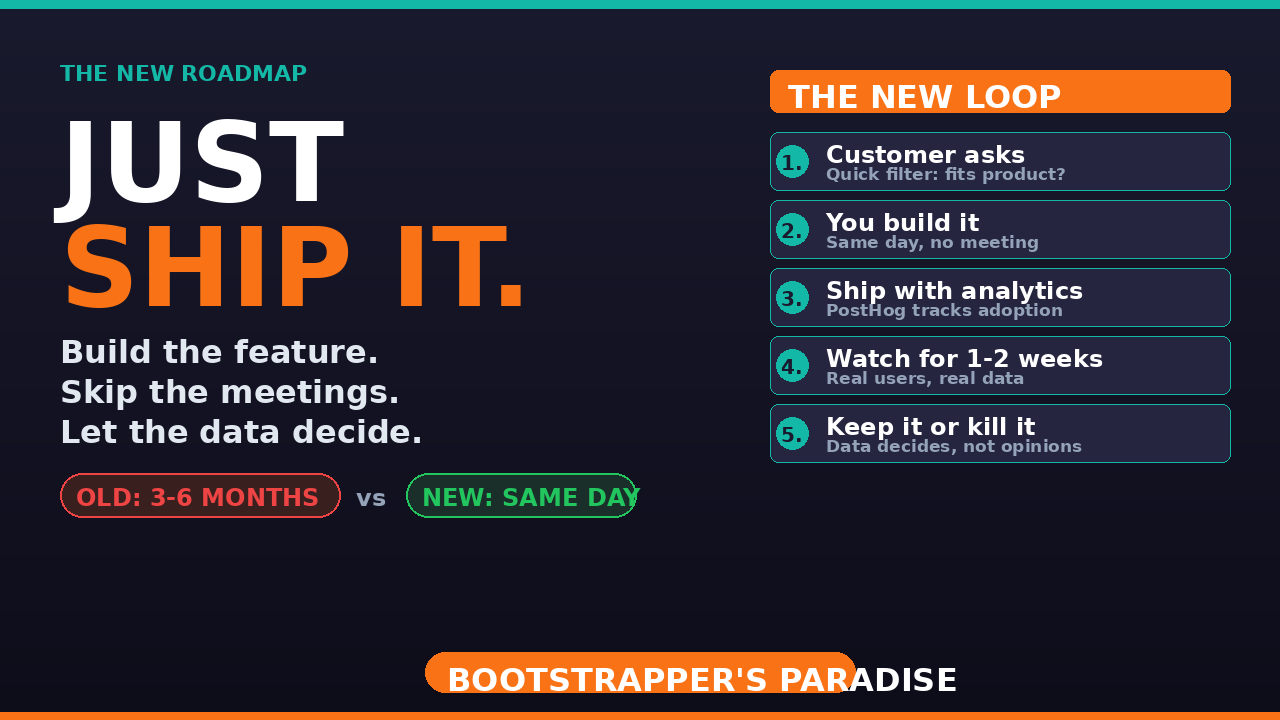
Here's what the loop looks like:
- A customer asks for something
- You build it
- Ship it with analytics
- Watch the data for a week or two
- Decide — keep it and make it better, or kill it and move on
The entire cycle happens in days, not months. You can run through this loop multiple times in the time it used to take to get a single feature through a traditional product committee.
Here's the other thing that happens when a feature works: you know exactly who's using it. You can reach out to those specific users. Ask them what they like. Ask them what could be better.
You get targeted, high-quality feedback from people who are actually engaged with the feature. Not hypothetical feedback from people in a survey who may never use it.
That's the difference between speculative research and evidence-based iteration. One is based on what people say they would do. The other is based on what people actually did.
Your Speed Advantage as a Solo Founder
Your advantage as a solo bootstrapped SaaS founder is speed. Lean into that as hard as you possibly can.
Big companies cannot do this. They have product committees and sprint planning and stakeholder reviews and compliance checkpoints. A feature request in an enterprise company enters a pipeline and emerges six months later — if it survives at all.
You can turn a customer conversation into a shipped feature before lunch.
That is a superpower. Don't waste it by recreating the bureaucracy of the companies you're competing against.
The Takeaway
Just ship it and go from there.
Don't over-plan. Don't over-research. Don't let perfect be the enemy of shipped.
Build it, measure it, decide based on the data.
Your homework: look at your feature backlog right now. Pick one thing a customer has asked for that seems reasonable. Build it this week. Wrap analytics around it. Ship it. Watch what happens.
I'd bet you'll learn more from that single experiment than from three months of planning.
Free Tools to Help
If you want help validating your SaaS idea before you even start building, try the free tools that go with this work:
- SaaS Idea Validator — pressure-test whether your problem is worth solving: tools.bootstrappersparadise.com/validator
- Problem Finder — discover real problems people will pay to solve: tools.bootstrappersparadise.com/problem-finder
- Pricing Calculator — figure out what to charge based on the value you create: tools.bootstrappersparadise.com/pricing
Once you have that confidence, the rest is just shipping.
Sean is building Clockless, a legal billing SaaS, in public at bootstrappersparadise.com. Join the free 5-day email course to learn the bootstrapper's approach to building SaaS with AI.
Ready to Build Your Own SaaS?
Learn how to go from idea to launch in my free 5-day email course — no coding or big budget required.
Start the Free Course